
| Advert Type | Vehicle Model, Part Or Accessory Name |
Part No. Or Vehicle Year |
Price | Advert Status | Actions |
|---|---|---|---|---|---|
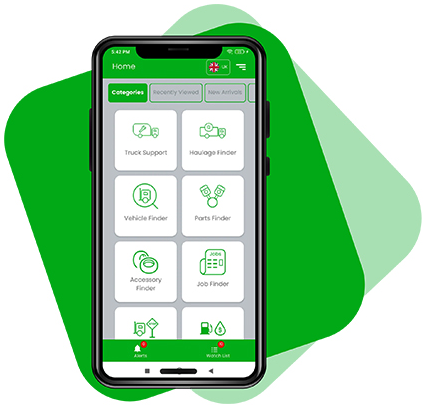
 Download our New App


Main Menu
Blog » Truck Parts
OEM vs Non-OEM Truck Parts - What Every Haulier Needs to Know
TRUCK MAINTENANCE · PARTS GUIDE · UK & EUROPE
OEM vs Non-OEM Truck Parts:
What Every Haulier Needs to Know
Genuine manufacturer parts versus quality aftermarket alternatives — the debate that divides fleet managers, owner-operators and workshop engineers across the UK. We break down exactly what the difference means, where it matters most, and how to make the right call every time.
Published: [28/06/2026] | By Gary Walsh
Every time a truck goes into the workshop — whether it's a scheduled service, an unexpected breakdown, or a full engine rebuild — the same question surfaces: do you fit a genuine OEM part, or do you go with a non-OEM alternative? It's a question that carries real financial and operational weight, and the answer is rarely as simple as 'always buy genuine' or 'aftermarket is just as good'.
The UK truck parts market is worth billions annually, and the choice between OEM and non-OEM affects everything from warranty validity and downtime risk to running costs and resale value. For owner-operators watching margins carefully, and for fleet managers responsible for dozens of vehicles, getting this decision right — consistently, across every component category — is a competitive advantage.
This guide covers the full picture: what OEM and non-OEM actually mean in practice, where each option makes sense, which components demand genuine parts and which don't, and how the TrucksLife Parts Finder helps you source the right part at the right price without the guesswork.
What Does OEM Actually Mean?
OEM stands for Original Equipment Manufacturer. In the context of truck parts, an OEM part is one made by — or made to the exact specification of — the vehicle manufacturer whose name is on the cab door. When Volvo, DAF, Mercedes-Benz, Scania, MAN or Iveco supply a replacement part through their official dealer network, that is an OEM part.
It's worth noting an important nuance here: OEM does not always mean the truck maker physically manufactured the component themselves. Major manufacturers outsource the production of many components to specialist suppliers — ZF for gearboxes, Knorr-Bremse for braking systems, Bosch for fuel injection, Wabco for air management. The truck manufacturer then badges and packages these components for their dealer network and sells them as official OEM parts.
This distinction matters enormously, and we'll come back to it — because that same Knorr-Bremse brake caliper sold as a Volvo OEM part through a Volvo dealer can also be purchased directly from Knorr-Bremse or through an authorised parts distributor, sometimes at significantly lower cost, with identical build quality.
What Are Non-OEM / Aftermarket Parts?
Non-OEM parts — also called aftermarket parts — are components manufactured by third parties that are designed to fit and function in place of the original part. The aftermarket ranges enormously in quality, from premium-grade parts produced by the same tier-one suppliers that make OEM components, right down to low-cost pattern parts of uncertain provenance.
The key categories within the aftermarket are:
· — Premium aftermarket / OE-equivalent
Parts made by the same manufacturers that supply the truck makers (ZF, Bosch, Knorr-Bremse, Mahle, etc.) sold through independent channels. Functionally identical to OEM, often at 20–40% lower cost.
· — Quality aftermarket
Parts from reputable independent manufacturers who produce to high but not identical OEM specifications. Reliable for many component categories, particularly wear items like filters, belts and brake linings.
· — Economy / pattern parts
Lower-cost parts that replicate the OEM form factor but with cheaper materials or looser tolerances. Fine for low-risk consumables; potentially risky for safety-critical or high-stress components.
· — Used / salvage parts
Removed from donor vehicles. Can represent excellent value for certain components — body panels, trim, mirrors, some chassis parts — when condition is verified and provenance is known.
Key insight: Saying 'I only fit OEM' or 'I always use aftermarket' is a false binary. The right approach is component-specific — and understanding which category each part falls into is where real cost control happens.
The Case for OEM Parts
There are clear, well-founded reasons why many fleet operators default to OEM for the majority of their parts purchasing. The argument for genuine parts is strongest in four areas.
1. Guaranteed Fit and Compatibility
OEM parts are engineered to the exact tolerances of your specific truck model and production year. There is no ambiguity about fitment, no risk of discovering that a part listed as compatible doesn't quite align with your variant. For complex assemblies — AdBlue injectors, EGR valves, turbocharger actuators, electronic control units — exact specification is not optional.
2. Warranty Protection
If your truck is within its manufacturer warranty or an extended service plan, fitting non-OEM parts can give the manufacturer grounds to void the warranty on affected systems. This is less of an issue for older, fully depreciated fleet vehicles, but for trucks within their first three years it represents a significant financial risk. Always check your warranty terms before fitting aftermarket parts to a vehicle still under cover.
3. Dealer Support and Traceability
OEM parts purchased through an authorised dealer come with full traceability — batch numbers, compliance certificates and a direct line back to the manufacturer if a fault emerges. In the event of an incident, being able to demonstrate a full OEM parts and service history protects both the operator and the vehicle's resale value. This matters particularly for operators subject to DVSA audits or those maintaining Earned Recognition status.
4. Safety-Critical Systems
For components directly involved in active safety — ABS modulators, EBS (Electronic Braking Systems), steering linkages, kingpins, fifth wheels — many operators and workshop engineers consider OEM non-negotiable. The engineering tolerances on these systems are extremely tight, and the consequences of a substandard part failing are severe.
The Case for Non-OEM and Aftermarket Parts
The aftermarket parts sector exists for good reason, and when used intelligently it delivers real, measurable benefit to operators who understand where the value lies.
1. Significant Cost Savings on Wear Items
Filters — oil, fuel, air, cabin, AdBlue — are the most purchased consumable parts on any HGV. A premium aftermarket oil filter from a brand like Mann+Hummel or Mahle (both of which supply to OEM programmes) can cost 30–50% less than the dealer-boxed equivalent while being manufactured in the same facility to the same specification. Across a fleet of 20 trucks serviced quarterly, that saving is material.
The same principle applies to brake pads and linings, clutch plates, fan belts, water pumps, alternators and starter motors — categories where the aftermarket has been well-established for decades and where quality is consistent and reliable from reputable suppliers.
2. Availability and Lead Times
A truck sitting off the road costs money — typically £500 to £1,500 per day depending on the operation. When a part is needed urgently, the aftermarket frequently has better stock availability than the OEM dealer network, particularly for older or out-of-production models. Dealers often need to order parts in from central distribution, whereas specialist independent parts suppliers regularly hold comprehensive stock across multiple makes and models.
3. Parts for Older Vehicles
For trucks more than seven or eight years old, the economics of OEM parts become increasingly difficult to justify. Dealer prices for components on older models can be high precisely because demand is lower and stock levels are reduced. The aftermarket, by contrast, continues to manufacture pattern parts for popular older models long after the manufacturer's own supply chain has moved on. For an owner-operator running a 10-year-old Actros or a 12-year-old FH, the aftermarket is often the only practical option.
4. The Tier-One Supplier Argument
This deserves particular emphasis. A significant proportion of what is sold as 'OEM' is manufactured by independent suppliers — Bosch, ZF, Continental, Hella, Knorr-Bremse, NGK, Valeo — who also sell the same or functionally equivalent parts through their own distribution networks. Buying a Bosch injector through a parts distributor rather than a branded Volvo box is not a compromise on quality. It is, in most cases, the same part at a lower price. Understanding this is central to intelligent parts procurement.
???? Always check the manufacturer stamp on the part inside the OEM box. If it matches a Tier-1 supplier you can source independently, you may be able to purchase the equivalent through a distributor at a meaningful saving.
OEM or Non-OEM? A Component-by-Component Guide
The most useful approach is not a blanket policy but a component-level framework. Here is how most experienced fleet engineers approach the decision across the key component categories.
Engine and Drivetrain
Injectors, turbochargers, EGR valves and timing components sit at the top of the precision engineering hierarchy. For current-generation engines with tight emissions calibration (Euro VI), the tolerance for substandard components is extremely low. Premium aftermarket or OE-equivalent from Bosch, Continental or Delphi is acceptable; economy pattern parts are not recommended in this category.
· Injectors — OEM or premium aftermarket (Bosch, Delphi) only
· Turbochargers — OEM or BorgWarner/IHI direct; avoid low-cost pattern
· Filters (oil, fuel, air) — premium aftermarket fine; excellent value
· Gaskets and seals — OEM recommended for head gaskets; aftermarket acceptable for minor seals
Braking Systems
Braking is the single most safety-critical system on a commercial vehicle, and it is also the category most frequently cited in DVSA prohibition notices. However, this does not automatically mean OEM-only. The key is sourcing from the actual system manufacturer.
· Brake pads and linings — premium aftermarket (Ferodo, Textar, TMD Friction) is well-established and DVSA-acceptable
· Brake chambers — Knorr-Bremse or Haldex direct where possible; verify quality tier carefully on economy options
· ABS modulators — OEM or direct from Knorr-Bremse / Wabco (now ZF)
· Slack adjusters — premium aftermarket is acceptable; economy pattern is not recommended
Suspension and Steering
Wear items like bushes, shock absorbers and leaf springs are a strong aftermarket category — well-established suppliers like Bilstein, Monroe and SAF have decades of proven performance in this space. Steering components warrant more care.
· Air suspension bags — Contitech / Firestone aftermarket widely accepted
· Shock absorbers — Bilstein, Monroe aftermarket fine
· Track rod ends and ball joints — OEM or premium aftermarket; economy not recommended
· Kingpins — OEM or BPW/SAF direct only for safety-critical axle components
Electrical and Lighting
Lighting is a category where aftermarket excels. LED headlamp and indicator assemblies, cab lighting, marker lights and trailer electrical components are all areas where aftermarket suppliers offer excellent quality at lower prices. ECUs and control modules are the exception — these are manufacturer-specific and almost always require OEM.
· Bulbs and LED lighting — aftermarket (Hella, Osram) is standard practice
· Alternators and starters — quality aftermarket (Bosch Reman, Valeo) is well-proven
· ECUs and control modules — OEM only; coding requirements make alternatives impractical
· Sensors (temperature, pressure, NOx) — OEM or Bosch/Continental direct recommended
Bodywork, Cab and Trim
This is the strongest aftermarket category. Bumpers, mirrors, steps, grab handles, cab panels and glass are made by aftermarket suppliers to fit every major truck model and the savings versus OEM dealer prices can be substantial — often 40–60%. Quality from established suppliers is consistently reliable and fitment is generally excellent.
· Bumpers, panels, mirrors — aftermarket standard practice; excellent value
· Windscreens and glazing — aftermarket (Pilkington, AGC) is industry standard
· Steps, grab handles, mudguards — aftermarket, no reservations
· Seats and cab interior — aftermarket widely available; check foam density and covering quality
Knowing the theory is one thing. Finding the specific part you need — at the right quality tier, from a trusted supplier, at a competitive price, with availability today rather than next week — is where the theory has to become practice. That is exactly what the TrucksLife Parts Finder is built for.
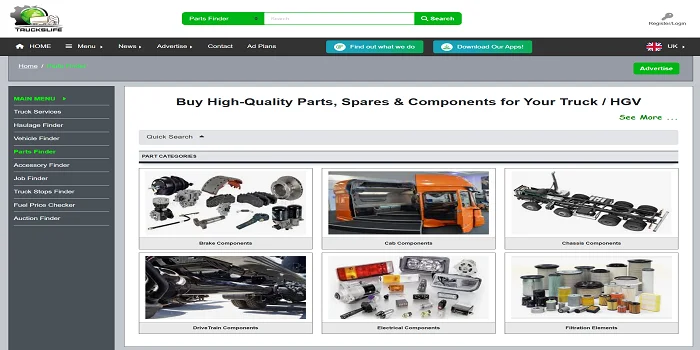
The Parts Finder at www.truckslife.com/parts/part-categories brings together new, used and salvage truck parts from suppliers across the UK and Europe in one searchable platform. Whether you need a genuine OEM component urgently, a premium aftermarket alternative at a better price point, or a sound used part for an older vehicle, the Parts Finder lets you search across all three categories simultaneously — so you can compare options and make an informed decision rather than defaulting to the nearest dealer out of convenience.
Using the TrucksLife Parts Finder you can:
· Search by part category — from engine and drivetrain through to cab, body, electrical and tyres
· Browse listings from independent parts suppliers, dealers and fleet dismantlers across the UK and Europe
· Find salvage and used parts from specialist dismantlers — ideal for older vehicles or bodywork
· List your own surplus or salvage parts if you're a supplier, dismantler or fleet operator
· Contact suppliers directly to confirm specifications, availability and shipping before committing
For operators managing multiple makes — an Actros alongside an FH alongside a CF — having a single platform that searches across all manufacturers simultaneously saves significant time. Rather than contacting four different dealers for four different makes, the Parts Finder surfaces all relevant options in one place.
Search the TrucksLife Parts Finder at www.truckslife.com/parts/part-categories — new, used and salvage HGV parts from verified UK & European suppliers. List your own parts free today.
Making the Right Call Every Time
The OEM versus non-OEM debate does not have a single correct answer — it has a correct framework. The right part for any given job depends on the component category, the age and value of the vehicle, the warranty position, the urgency of the repair, and the quality tier of what's available in the aftermarket at that moment.
Safety-critical systems — braking, steering, active safety electronics — demand the highest quality, whether that comes from an OEM box or directly from the Tier-1 system manufacturer. Wear items and consumables — filters, lighting, pads, belts, bodywork — are a natural home for premium aftermarket at meaningful savings. Older vehicles beyond their prime depreciation curve often make the aftermarket the only sensible economic option.
What matters in every case is that you know what you're buying. A premium Bosch component sourced through a reputable distributor is not a compromise — it is a smart procurement decision. A low-cost pattern part of unknown origin fitted to a safety-critical system is a false economy that can cost far more than it saved. The difference between those two outcomes often comes down to where and how you source.
TrucksLife is here to make that sourcing easier, faster and more transparent — connecting UK and European operators with the right parts, from verified suppliers, at competitive prices. Whether you're a one-truck owner-operator or a fleet manager responsible for 50 vehicles, the Parts Finder gives you the market in one place.
Author: Gary Walsh
Gary Walsh is the director of Life Internet Services Ltd, the company behind TrucksLife and TrailersLife. He oversees the development of specialist online platforms designed to connect the road transport industry across the UK and Europe. Through these platforms, Gary aims to make it easier for operators, dealers and drivers to find vehicles, source parts, discover services and access relevant industry opportunities.
|
About TrucksLife.com TrucksLife.com is the UK and Europe's dedicated online marketplace for the haulage and logistics industry. Buy and sell trucks, trailers and equipment; find parts, accessories and specialist services; search auction listings and connect with the wider trucking community — all in one platform. Register free at www.truckslife.com. |
TAGS: OEM truck parts | non-OEM truck parts | aftermarket HGV parts | truck parts UK | HGV parts finder | genuine vs aftermarket truck parts | truck parts supplier UK | truckslife parts finder | OEM vs aftermarket | commercial vehicle parts

THE ROAD TRANSPORT MARKETPLACE
KEEP YOUR BUSINESS MOVING
Your marketplace for trucks, parts, jobs and services across the road transport industry.
Trucks for Sale — Browse trucks and commercial vehicles.
Parts & Accessories — Find parts, spares and equipment.
Jobs & Services — Discover driving opportunities and transport services.